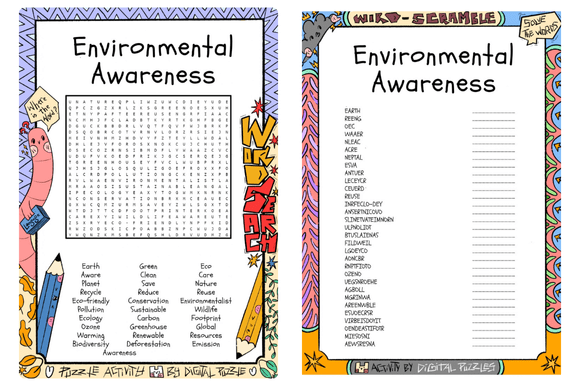
Environmental Awareness Word Search: A Gateway to Ecological Learning
In an era where digital distractions compete for every child's attention, finding engaging ways to introduce complex concepts like ecology can be a challenge for parents and educators alike. The Environmental Awareness Word Search has emerged as a powerful tool in the educational toolkit, offering a bridge between playful entertainment and meaningful learning. For second to fifth graders, these puzzles are not merely a pastime; they are a structured method to absorb vital ecological terminology while developing critical cognitive skills. By integrating these activities into your curriculum or home routine, you provide children with the vocabulary and curiosity needed to understand their role in protecting the planet.
Understanding the Power of Educational Puzzles
An Environmental Awareness Word Search is more than a grid of letters hiding words related to nature. It is a carefully designed educational resource that combines literacy practice with environmental science. These puzzles typically feature a list of terms such as "biodiversity," "recycling," "ecosystem," and "conservation." The task requires students to locate these words within a jumbled matrix, reinforcing spelling patterns and word recognition. When paired with word scramble activities, the cognitive load increases, challenging children to unscramble letters to form correct ecological terms before searching for them.
The primary goal of these resources is to demystify the language of environmentalism. Many children hear terms like "sustainability" or "carbon footprint" in passing but lack a concrete understanding of what they mean. By encountering these words repeatedly in a low-stakes, fun environment, students begin to internalize them. This repetition builds a foundational vocabulary that makes future lessons on climate change, habitat protection, and renewable energy much more accessible.
Addressing Common Educational Challenges
Teachers and parents often face specific hurdles when trying to teach environmental concepts to young learners. One significant challenge is maintaining engagement. Abstract concepts about global warming or deforestation can feel distant and overwhelming to a seven-year-old. Another common issue is the "attention span gap," where traditional lectures fail to hold the interest of active minds. Furthermore, there is often a need for differentiated instruction; a single classroom contains students with varying reading levels and learning speeds.
The Environmental Awareness Word Search directly addresses these pain points. It transforms passive listening into active participation. Instead of being told about the importance of bees, a student actively hunts for the word "pollination" in a grid, creating a mental connection between the term and the activity. For educators managing diverse classrooms, these puzzles offer a self-paced activity. Advanced readers can tackle complex grids with longer words, while those who need extra support can focus on shorter, simpler terms, all within the same thematic unit. This flexibility ensures that every child feels successful and included in the learning process.
Bridging Entertainment and Education
The most effective educational tools are those that do not feel like work. Children are naturally drawn to puzzles because they offer a clear objective and immediate gratification upon completion. An Environmental Awareness Word Search leverages this natural inclination. The visual appeal of well-designed worksheets, often featuring illustrations of forests, oceans, or animals, captures attention immediately. Once engaged, the child is unknowingly practicing fine motor skills, pattern recognition, and reading comprehension.
This approach aligns perfectly with the concept of gamified learning. By turning vocabulary acquisition into a game, the barrier to entry for difficult subjects is lowered. When a child successfully finds "photosynthesis" or "renewable energy," they experience a sense of accomplishment. This positive reinforcement encourages them to seek out more knowledge about the topic. Over time, the puzzle becomes a gateway to deeper inquiry. A child might ask, "What does 'endangered species' mean?" after finding it in a word search, prompting a rich conversation about wildlife conservation.
Practical Applications for Schools and Homes
The versatility of these resources makes them suitable for a wide range of settings. In the in-school environment, teachers can use Environmental Awareness Word Search puzzles as warm-up activities to start a lesson on Earth Day or as a quiet center activity during independent work time. They serve as excellent supplements to science units, providing a break from heavy textbook reading while reinforcing key concepts. For virtual classrooms, these printable or digital puzzles offer a tangible way for remote students to engage with the material, reducing screen fatigue associated with video calls.
For at-home enrichment, these worksheets are invaluable. Parents looking to extend learning beyond the school day can use them to spark family discussions about local environmental issues. Imagine sitting down with your child to solve a word scramble together, then discussing how you can apply the concept of "reduce, reuse, recycle" in your own kitchen. This shared activity strengthens the parent-child bond while instilling eco-friendly habits early on. Additionally, these puzzles are perfect for road trips, waiting rooms, or rainy days, ensuring that learning opportunities are available whenever and wherever.
Tailoring the Experience to Different Users
- Early Elementary (Grades 2-3): Focus on simpler grids with larger fonts and basic terms like "tree," "water," and "sun." Use word scrambles with fewer letters to build confidence. Pair the activity with drawing exercises where kids illustrate the words they found.
- Upper Elementary (Grades 4-5): Introduce more complex grids with diagonal and backward words. Include advanced vocabulary such as "biodiversity," "habitat loss," and "sustainable." Challenge students to write a sentence using three words they found in the puzzle to deepen their conceptual understanding.
- Homeschool Educators: Integrate these puzzles into a broader nature study curriculum. Use the completed word search as a springboard for field trips, science experiments, or community service projects focused on local clean-ups.
Long-Term Outcomes and Eco-Warrior Mindsets
The ultimate goal of utilizing an Environmental Awareness Word Search extends far beyond the completion of a worksheet. The long-term outcome is the cultivation of an "eco-warrior" mindset. By familiarizing children with the language of conservation, we empower them to articulate their concerns and take action. A child who understands the difference between "biodegradable" and "non-biodegradable" is more likely to make informed choices about waste disposal. A student who knows what an "endangered species" is may become an advocate for wildlife protection.
These activities foster a sense of agency. When children realize they possess the vocabulary to discuss environmental issues, they feel more capable of contributing to solutions. This shift from passive observer to active participant is crucial for the next generation of leaders. Furthermore, the habit of engaging with educational content through puzzles promotes a lifelong love of learning. It teaches children that education can be enjoyable, creative, and deeply connected to the real world.
Recommendations for Implementation
To maximize the impact of these resources, consider the following recommendations. First, ensure the materials are age-appropriate. While the Environmental Awareness Word Search targets second to fifth graders, individual reading levels vary. Choose puzzles that challenge the child without causing frustration. Second, integrate the puzzles into a larger context. Do not let the worksheet stand alone; follow up the activity with a discussion, a video, or a hands-on project related to the words found.
Third, celebrate success. Whether it is a sticker chart in the classroom or verbal praise at home, acknowledging the effort put into solving the puzzle reinforces positive behavior. Finally, look for resources crafted by experienced educators. High-quality materials will have accurate definitions, engaging visuals, and a logical progression of difficulty. By selecting expertly designed activities, you ensure that the time spent is both entertaining and educationally sound.
In conclusion, the Environmental Awareness Word Search is a simple yet profound tool for shaping young minds. It meets children where they are, using play to unlock understanding. Whether you are a teacher seeking a fresh lesson plan or a parent wanting to nurture a love for nature, these interactive puzzles offer a practical, effective, and enjoyable solution. Let us turn our children into little eco-warriors, one word at a time.