Essential Tools Equipment Flashcards: A Practical Guide to Better Learning
Learning the names and functions of tools is a foundational skill for anyone entering the trades, managing home improvement projects, or simply expanding their English vocabulary. However, many learners struggle with retention because they rely on abstract lists or low-quality illustrations that fail to represent reality. This is where Essential Tools Equipment Flashcards become a critical resource. By bridging the gap between text and real-world application, these visual aids transform a potentially dry subject into an engaging, hands-on experience.
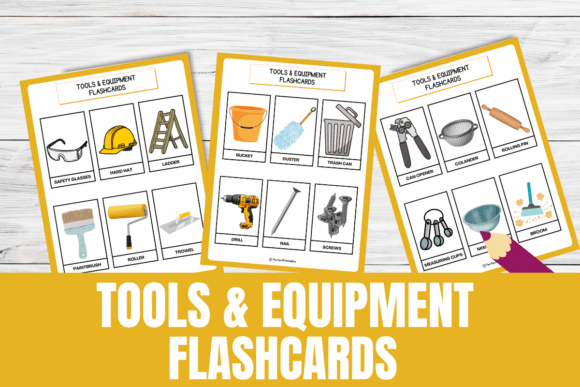
The specific set featuring 60 high-quality images is designed to do more than just list items; it helps learners recognize and name common tools used in construction, home improvement, and daily tasks. Whether you are an educator preparing a vocational lesson, a parent homeschooling a child, or an ESL student building technical vocabulary, the quality of your learning materials directly impacts your success. Yet, not all flashcard resources are created equal, and choosing the wrong ones can lead to confusion rather than clarity.
Why Real Images Matter More Than You Think
One of the most common mistakes learners and educators make is settling for cartoon-style drawings or generic clip art when studying equipment. While cartoons have their place in early childhood education, they often lack the nuance required for adult learners, trade students, or serious hobbyists. A drawing of a "hammer" might look like any hammer, but in the real world, a claw hammer looks distinctly different from a sledgehammer or a ball-peen hammer.
When you use Essential Tools Equipment Flashcards featuring real pictures, you eliminate this ambiguity. The brain processes real-world imagery differently than stylized graphics. Seeing the actual texture of a wrench, the specific shape of a drill bit, or the safety features on a saw creates a stronger neural connection. This is particularly vital for ESL and ELL learners who may never have seen certain tools in person. Without accurate visual references, students might memorize the word "drill" but fail to identify a cordless impact driver versus a standard rotary drill when they encounter one on a job site.
Avoiding Common Pitfalls in Vocabulary Acquisition
Even with good content, the method of delivery can undermine the learning process. Many people approach vocabulary building by passively flipping through cards once or twice, expecting immediate mastery. This is a fundamental misunderstanding of how memory works. True retention requires active recall and spaced repetition. If you simply glance at a card, read the label, and move on, you are likely to forget the term within days.
Another frequent oversight is ignoring the context of the tool. A flashcard that shows a tool in isolation is useful, but it becomes far more powerful when paired with the concept of its use. For example, knowing what a "level" is good, but understanding that it is used to ensure surfaces are perfectly horizontal or vertical is better. The Montessori-style three-part cards included in this set are excellent for this because they separate the image, the label, and the control of error, allowing for self-correction without constant teacher intervention.
Furthermore, many users fail to leverage the printable and interactive nature of these resources. Printing them out is not just about having a physical copy; it is about creating a tactile learning environment. Handling the cards, sorting them by category (e.g., cutting tools vs. measuring tools), and using them in matching games significantly boosts engagement compared to staring at a screen. Ignoring the physical aspect of learning reduces the efficiency of the study session and can lead to frustration when progress feels slow.
How to Evaluate and Choose the Right Resource
Before downloading or purchasing any set of educational materials, it is crucial to evaluate the quality and relevance of the content. Not every set labeled "tools" will be suitable for your specific needs. For instance, a set designed for toddlers might include basic toys as "tools," which is unhelpful for a trade school student or an adult learner. Conversely, a set too advanced for a beginner might overwhelm them with jargon.
When assessing Essential Tools Equipment Flashcards, check the following details:
- Image Quality: Are the photos clear, well-lit, and showing the tool from a recognizable angle? Blurry or cropped images can hinder recognition.
- Vocabulary Accuracy: Do the labels use standard industry terms? In some regions, a "spanner" is called a "wrench." Ensure the terminology matches the dialect or region you are teaching or learning.
- Diversity of Tools: Does the set cover a broad range of categories? A good set should include hand tools, power tools, measuring instruments, and safety gear.
- Format Flexibility: Can the cards be printed easily? Is there a digital version for interactive use on tablets?
If a resource lacks high-quality real images, it may save money upfront but cost you time later as you struggle to correct misconceptions. Investing in a comprehensive set like the 60-card collection ensures you have a robust foundation to build upon.
Practical Strategies for Maximum Impact
To get the most out of these flashcards, integrate them into a structured routine. For teachers introducing tools in technical lessons, start by grouping the cards by function. Ask students to sort the cards before revealing the answers. This forces them to think critically about what each tool does, even if they don't know the name yet.
For parents and homeschoolers, turn the learning process into a game. Hide the cards around the house or workshop and have the learner find the tool that matches the picture. This connects the vocabulary to the physical object in their environment. For ESL learners, focus on pronunciation alongside recognition. Use the cards to practice sentences like, "I need a screwdriver to fix this," rather than just saying "screwdriver."
Trade school students can use these cards as a quick review tool before exams or practical assessments. Keep a small deck in your pocket during breaks to test your knowledge. The goal is to move from passive recognition to active identification. When you see a tool on a shelf, you should immediately know its name and primary function without hesitation.
Building Confidence Through Visual Mastery
The ultimate benefit of using Essential Tools Equipment Flashcards is the confidence they instill. Whether you are walking onto a construction site for the first time or helping your child build a treehouse, knowing the right words and recognizing the right tools makes you feel capable and prepared. Misunderstanding a tool's name or function can lead to inefficiency, wasted materials, or even safety hazards. By ensuring your vocabulary is precise and your visual recognition is sharp, you protect yourself and those around you.
Don't let poor learning materials hold you back. Avoid the trap of generic lists and low-quality graphics. Instead, choose resources that prioritize realism, accuracy, and interactivity. With the right approach and the right tools—both the physical ones and the educational ones—you can master the language of the trades and improve your skills in any setting. These 60 flashcards are more than just a study aid; they are a bridge to competence and confidence in the real world.