Educational and Scientific Icons Collection
In the visual landscape of modern communication, clarity is currency. Whether you are designing a presentation for a university board, creating an infographic for a science blog, or building a user interface for an educational app, the symbols you choose dictate how quickly your audience grasps your message. The Educational and Scientific Icons Collect offers a curated solution to this challenge. It is not merely a pack of graphics; it is a visual vocabulary designed to bridge the gap between complex concepts and immediate understanding. This collection brings together essential elements of learning and discovery into a cohesive set that empowers creators to communicate with precision and style.
The Power of Visual Consistency in Science and Education
One of the most significant hurdles in scientific and educational design is maintaining consistency while covering diverse topics. A single project might need to reference biology, physics, astronomy, and mathematics simultaneously. Without a unified visual language, these disparate subjects can look disjointed, confusing the viewer and diluting the core message. The Educational and Scientific Icons Collection solves this by providing a standardized aesthetic across all disciplines.
From the double helix of DNA to the orbit of a satellite, every icon shares the same stroke weight, line quality, and geometric logic. This uniformity allows designers to mix and match symbols without worrying about visual clashes. When a microscope sits next to a graduation cap or a chemistry flask appears beside a globe, they feel like part of the same narrative rather than random clip art pasted onto a slide. This consistency builds trust with the audience, signaling that the content behind the visuals is just as organized and reliable.
Core Elements of the Collection
The strength of this set lies in its comprehensive coverage of key themes. It moves beyond generic representations to include specific tools and symbols that resonate with experts and students alike. You will find:
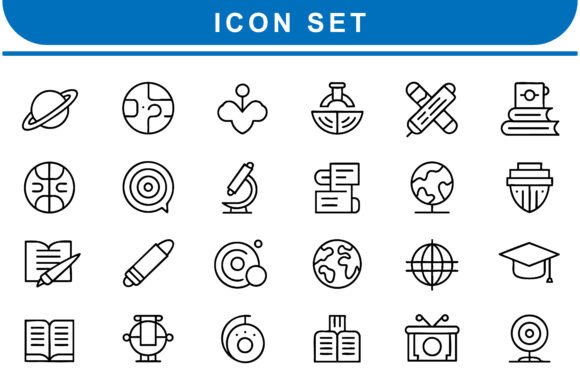
- Natural Sciences: Detailed outlines of atoms, DNA strands, microscopes, and chemistry flasks that capture the essence of biological and chemical research.
- Physical Sciences & Astronomy: Icons representing planets, satellites, telescopes, and physics formulas, perfect for illustrating space exploration or theoretical mechanics.
- Academic Tools: Essential items like books, pencils, globes, podiums, and graduation caps that symbolize the journey of learning from elementary school to university.
- Technology & Innovation: Modern additions such as web cameras, target symbols for goals, and digital interfaces that reflect the current state of remote learning and data-driven research.
Each element is available in both EPS and JPG formats, ensuring versatility. The vector-based EPS file allows for infinite scalability without loss of quality, making it ideal for large-format printing or high-resolution screens. The JPG version provides a quick, ready-to-use option for web drafts or social media posts where speed is essential.
Creative Applications for Designers and Educators
The utility of the Educational and Scientific Icons Collect extends far beyond simple decoration. For graphic designers, it serves as a foundational toolkit for branding educational institutions or launching new ed-tech products. Imagine a logo for a coding bootcamp that combines a laptop with a mathematical symbol, or a brochure for a planetarium that uses a sleek outline of a satellite to draw the eye. The clean, modern style of these icons ensures they fit seamlessly into minimalist designs, flat layouts, and even more elaborate illustrations.
For educators and content creators, these icons act as cognitive anchors. In an era of short attention spans, a well-placed icon can break up dense text and highlight key takeaways. Consider a teacher preparing a lesson plan on climate change; using a globe icon alongside a thermometer and a factory symbol can instantly convey the relationship between global warming and industrial activity. Similarly, a blogger writing about the history of medicine can use a microscope and a book icon to visually separate sections on ancient remedies versus modern diagnostics.
Adapting the Style for Different Audiences
While the icons are designed with a modern, simple aesthetic, their application can be tailored to suit various demographics. For a young audience in primary education, these icons can be filled with bright, bold colors to create engaging worksheets and interactive whiteboard activities. The simplicity of the outline makes them easy to color, turning a static image into an active learning tool.
Conversely, for a professional audience of researchers or corporate trainers, the icons work best in monochrome or muted tones. A dark grey or navy blue outline conveys sophistication and seriousness, fitting perfectly into annual reports, conference slides, or academic journals. The ability to manipulate the color palette while retaining the structural integrity of the vector file gives users complete creative control. This flexibility ensures that the same asset library can support a kindergarten classroom and a PhD dissertation defense.
Strategic Implementation in Digital Projects
In the digital realm, load times and responsiveness are critical. The Educational and Scientific Icons Collection is optimized for web performance. Because the icons are simple and outlined, they translate beautifully into SVG format for responsive websites. This means they remain crisp on mobile devices, tablets, and 4K monitors alike. For web developers, this reduces the need for multiple image sizes, streamlining the development process.
Marketing teams can leverage these icons to create compelling infographics that explain complex data sets. Instead of overwhelming readers with walls of text, a series of icons—such as a target for objectives, a graph for results, and a lightbulb for innovation—can guide the reader through a story. This approach aligns with the principles of effective information design: reducing cognitive load and enhancing retention.
Furthermore, the inclusion of technology-related icons like the web camera and satellite reflects the shifting landscape of modern education. As remote learning becomes standard, visual cues that represent connectivity and digital access are more relevant than ever. Using these symbols helps brands position themselves as forward-thinking and adaptable to new technological realities.
Maintaining Clarity and Originality
While the collection provides a robust starting point, the true value comes from how these assets are integrated into a larger design system. To maintain originality, avoid simply dropping icons onto a blank canvas. Instead, use them to reinforce typography and layout. Group related icons to create clusters of meaning, or use them as bullet points to structure lists effectively. The goal is to ensure that the visuals serve the content, not distract from it.
Consistency is also key when mixing these icons with other brand assets. Ensure that the stroke weight and corner radius of the Educational and Scientific Icons match your existing brand guidelines. If your brand uses rounded corners, consider modifying the sharp edges of the icons slightly to achieve harmony. By treating these icons as part of a holistic design strategy, you elevate the overall quality of your output.
Ultimately, the Educational and Scientific Icons Collect is more than a download; it is a resource for clear thinking and effective communication. Whether you are a freelancer pitching a concept, a publisher laying out a textbook, or a scientist presenting groundbreaking research, having the right visual tools at your disposal makes all the difference. These icons empower you to turn abstract ideas into tangible, understandable visuals, fostering a deeper connection with your audience and driving your message home with impact.